| For optimal viewing on mobile devices, please download the pdf |
As the leaves come down across Bethesda this fall, I keep noticing the same sight on almost every walk: a chain-link fence, a dumpster, and a builder’s sign where a 1950s rambler stood last spring.
Between 2020 and 2025, 858 new detached infill homes were built in Bethesda. That works out to about 143 a year, or one new house every two and a half days.
I’ve watched this cycle for more than twenty years. This fall I wanted to measure two things at once: what the finished homes sell for, and what builders pay for the ground. To accomplish that, I went through the public tax records and MLS histories for every one of these homes.
In Bethesda today, land accounts for roughly 40% of the price of a new home. That figure has become a major driver of pricing across the entire new-construction market. Everything else in this report flows from it.
The Bigger Picture: Rates Are Moving the Wrong Way
The market backdrop is more challenging than it was a year ago. The Fed raised rates in September, held them steady at 3.75%–4.00% in October, and markets anticipate another hike in December. It is important to remember, however, that the Fed doesn’t set your mortgage rate; the 10-Year Treasury does. With the 10-Year near 5%, the 30-year fixed is at 7.24%.
Yet new-home prices in Bethesda kept rising straight through the rate spike of 2022–23. Buyers at $2.5 million are far less rate-sensitive than the market as a whole, and many pay cash. The fundamentals that support the Bethesda housing market haven’t changed: high household incomes, stable employment in federal and defense sectors, law and biotech, and access to some of the best public and private schools in the country.
Five Years of New Homes: Same House, Higher Price
Builders have kept a remarkably steady pace, about 120-130 new homes a year since the 2020 peak of 210. The real change hasn’t been the number of homes built - it’s been the price.
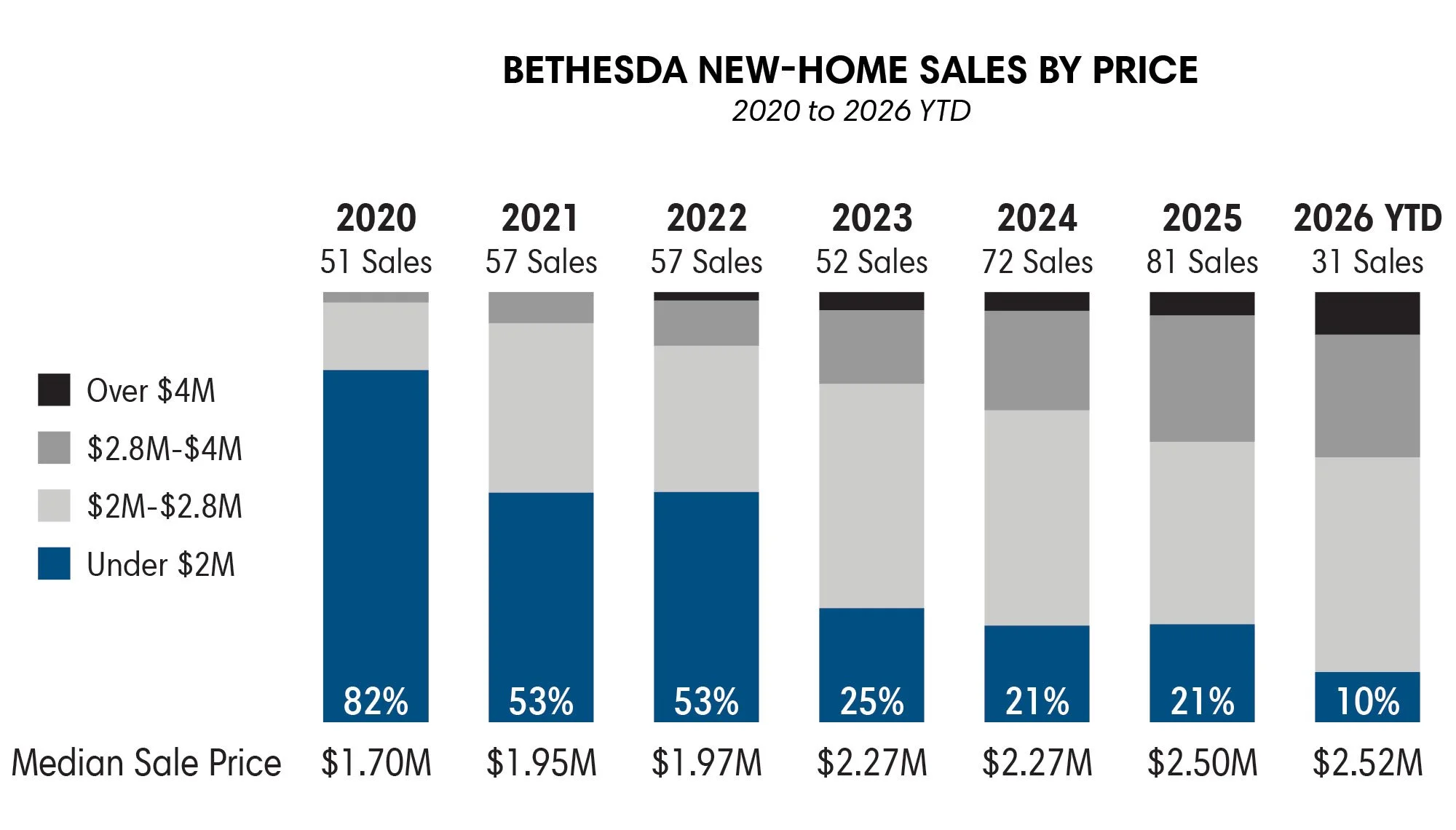
Montgomery County tax records, 401 recorded sales of new detached
homes built 2020–2025, by year of sale; 2026 through October.
The median price of a new home was $1.70 million in 2020. This year, it’s $2.52 million - a 48% increase. Yet homes haven’t gotten any bigger. In other words, buyers are paying nearly 50% more for essentially the same house.
For resales, I’ve long tracked homes under $1 million as my measure of affordability. For new construction, that benchmark is $2 million, and the number of homes selling below it has nearly disappeared. In 2020, 82% of new homes sold below $2 million. This year, that figure has dropped to just 10%.
What Builders Pay for the Ground
I traced 42 recently constructed homes back to the day the builder bought the lot. The median lot cost $1,097,500, and the lot came to 39.8% of the final sale price.
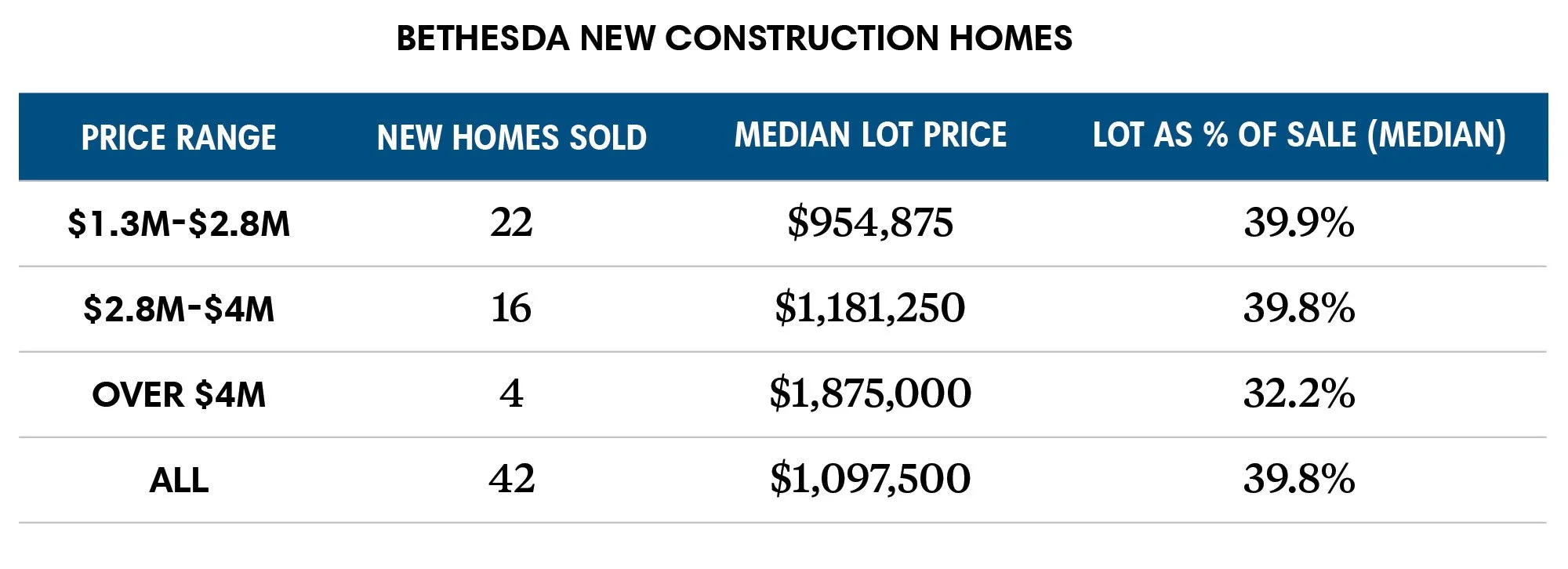
That 40% is remarkably steady from a $1.9 million house to a $4 million one. It’s the discipline of value at work: a builder starts with what a finished home on that street will sell for and works backward to what the land is worth. Only at the very top does the ratio loosen, because the house itself starts to account for a greater share of the value.
Edgemoor, as always, is its own world: lots there have traded at $2.3 million to $3.5 million.
Location, School and the Beltway
Zip codes typically do not set prices in Bethesda. Many different factors and nuances do, but three stand out: how close a home is to downtown Bethesda or the DC line, which high school it feeds into, and which side of the Beltway it sits on.
The clearest example: Kenwood Park and Wyngate share a zip code and both sit inside the Beltway. Kenwood Park feeds Whitman and Wyngate feeds Walter Johnson, and a new home in Kenwood Park sells for about 26% more per square foot.
Whitman has led the way. It accounts for nearly half of all new construction, and its price per foot is up 36% since 2020–21, against 26% for Walter Johnson. Close-in B-CC neighborhoods command the highest price per foot of all, which is the premium for walking to downtown. Outside the Beltway toward North Bethesda (Lone Oak and Ashburton, for example), builders build smaller homes on smaller lots, and that is where a brand-new home can still come in around $2 million.
Again, in a category of its own, is Edgemoor where recent new homes have sold around $7 to $9 million.
What It Means for You
Sellers:
If you own an older home on a desireable lot, there’s a quick test you can run. Look at what new construction on your street is selling for and take about 40% of that price as a starting point. If new homes nearby are closing at $2.7 million, a builder may be willing to pay around $1.05–$1.1 million for your property, whatever the condition of your kitchen. Builders often move quickly, pay cash, and buy as-is. For many longtime owners that is the simplest path to a sale.
However, don’t discount the growing pool of young families looking to get into Bethesda, who will often pay more for the house than a builder would pay for the land. Sometimes that difference is more than enough to cover the additional costs of a traditional sale. I urge you to call a real estate professional to have that conversation and run the numbers on both scenarios.
Buyers
If you're buying new construction, keep in mind that roughly 40% of the purchase price is attributable to the land. Unlike the house itself, land doesn't depreciate. So give the lot, the street, and the school district just as much consideration as the finishes inside the home.
If you're wondering what a builder would pay for your home, or whether a new home you're considering is priced right against its land, call me. I'd love to run the numbers with you.
Warmly,
Avi